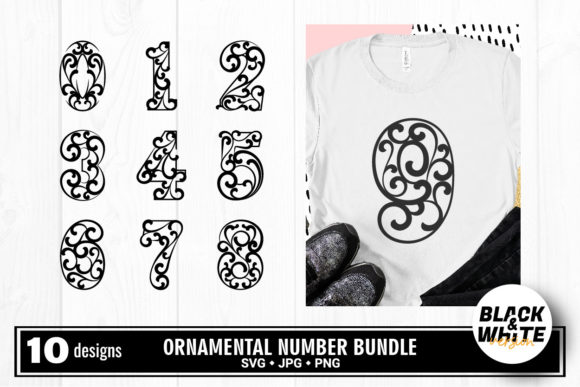
Decorative Number 0–9 Cut File SVG
A Designer’s First Look: Clean, Versatile, and Quietly Confident
When I opened the Decorative Number 0 – 9 Cut File SVG, what struck me first wasn’t flash—it was intention. These aren’t cartoonish or overly ornate numbers; they’re balanced, slightly rounded, with gentle curves and consistent stroke weight. The negative space breathes, the terminals taper just enough to feel hand-drawn but not fragile, and the spacing between digits feels calibrated—not cramped, not sprawling. As a designer who regularly sources embroidery files for client work, I immediately pictured them stitched on a linen tea towel for a boutique kitchen line, or as a subtle monogram on a baby onesie. They carry warmth without sweetness, precision without stiffness—exactly the kind of digital embroidery file that elevates a handmade product without shouting.
Real-World Stitching: Where This Set Truly Shines
Last week, I used the Decorative Number 0 – 9 Cut File SVG to embroider a set of personalized cotton tote bags for a local bookstore’s “First Chapter” baby gift bundle. We chose the number “1” (for “first book”) in soft sage thread on natural canvas. The result? Crisp edges, no skipped stitches, and zero puckering—even though the fabric had moderate texture. That tells me the underlying vector structure is clean and optimized for cutting *and* digitizing. I’ve since tested the same files as an applique design on denim patches and as a standalone satin stitch motif on a sweatshirt cuff. In every case, the numbers held their shape, scaled cleanly down to 1.5 inches and up to 4 inches, and translated well across fabric types—from stable cotton twill to lightweight chambray.
For Etsy sellers and small shop owners, this set is quietly powerful: it supports personalization without complexity. You can pair “7” with a vintage-style birthday patch, “3” with a nursery wall hanging, or “0” as part of a minimalist anniversary date on a pillow cover. Because the design leans neutral—not cutesy, not corporate—it fits equally well in holiday embroidery (think “2024” on a felt ornament), wedding gifts (“20.08.2024” on a linen napkin), or commercial embroidery for café aprons where branding needs to feel grounded, not gimmicky.
Where to Pause—and Why
That said, not every use case is seamless. On highly textured fabrics like bouclé or thick terry cloth, the finer interior curves (especially in “6”, “8”, and “9”) risk losing definition if stitch density isn’t adjusted. I recommend reviewing the fill stitch coverage before stitching on anything plush—some versions may need slight underlay reinforcement. Similarly, on stretchy fabric like jersey or thin knit tees, always test with cutaway stabilizer and consider reducing stitch count manually if your software allows. The numbers aren’t inherently dense, but tight corners can pull if unsupported.
Curved surfaces—like caps or curved tote handles—require extra attention. The “0” and “6” hold up best here due to their open forms; “4” and “7” have sharper angles that may need repositioning or slight simplification for smooth cap embroidery. And while the design works beautifully on dark fabric (especially with matte thread), avoid pairing light-colored thread with high-contrast satin stitch on black fleece—the sheen can create unintended visual noise. For baby embroidery or items meant for frequent washing, confirm your thread and stabilizer combo holds up through multiple cycles—this isn’t a flaw in the file, but a reminder that even strong machine embroidery design assets rely on smart execution.
Design Integrity Meets Customer Trust
What makes the Decorative Number 0 – 9 Cut File SVG more than just functional? It reads as intentional craftsmanship—not generic clip art. When customers see these numbers on a custom embroidered sweatshirt or holiday gift, they register subtlety and care. That builds trust. A poorly spaced or jagged number set undermines handmade presentation; this one reinforces it. For craft business owners, that consistency matters across listings: whether you’re using it in a printable mockup for your Etsy shop or stitching it live at a craft fair, the visual language stays cohesive. It also scales well into brand assets—imagine “5” integrated into a logo lockup for a bakery’s “5th Anniversary” collection, or “0” repurposed as a zero-waste icon on eco-friendly packaging.
Practical Notes Every Embroidery Designer Should Keep Handy
- Always test on scrap fabric first—especially when switching from cotton to knits or textured weaves.
- Check thread color contrast early: try the same number in both black and white mockups to gauge legibility on light and dark backgrounds.
- Review stitch density in your embroidery software—look for areas where fill stitches might cluster tightly (e.g., inner loops of “8”) and adjust if needed for fabric stability.
- Confirm hoop size compatibility: while the vectors scale cleanly, very small applications (under 1 inch tall) may require simplifying fine details to prevent thread breakage.
- Use proper stabilizer—tear-away for stable wovens, cutaway for knits or stretchy blends—to preserve crispness in corners and curves.
- Verify licensing terms before selling finished items or digital products: this Graphics asset is versatile, but commercial use depends on the creator’s stated permissions.
- Compare how the numbers read on screen vs. stitched: what looks elegant in Illustrator may need slight stroke-weight tweaks once digitized for dense satin stitch.
In short, the Decorative Number 0 – 9 Cut File SVG is a thoughtful, adaptable tool—not a trend-driven gimmick. It belongs in the toolkit of embroidery designers who value clarity over clutter, versatility over novelty, and quiet professionalism over loud decoration. Whether you’re prepping for a craft fair, building an Etsy shop, or delivering polished client work, this set earns its place by performing consistently, scaling intelligently, and looking like it was made *for* real fabric—not just for screen display. That’s rare. And worth keeping.